
 Taken from the RI website HERE
With a US$2 million Rotary Programs of Scale award, a project makes high-quality care available to pregnant women, mothers, and newborns in Nigeria
Now the data is in for the three-year program’s first two years. By the end of 2024, Together for Healthy Families in Nigeria had trained 1,146 health workers in emergency obstetric and neonatal care, respectful maternity care, data entry, and community outreach. Community health extension workers conducted nearly 26,000 home visits and led community dialogues that reached more than 36,000 people. And birthrates at health care facilities supported by the program increased by up to 35%.
Below, our writer provides a close-up view of this remarkable program.
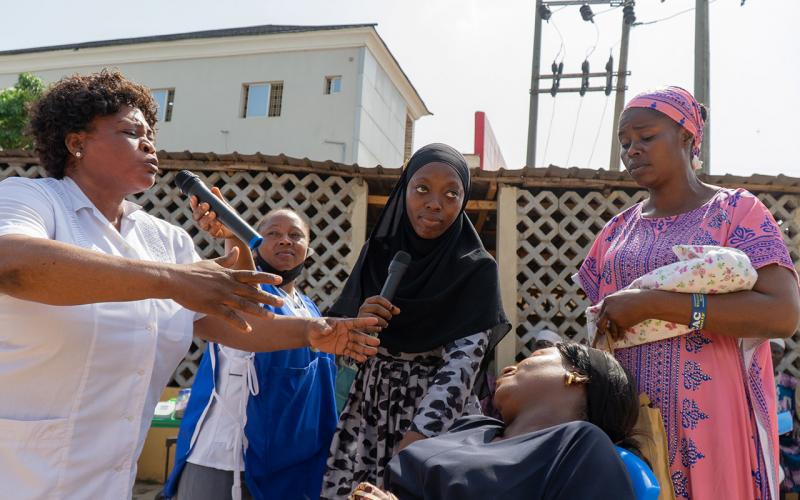
On the outskirts of Abuja, beneath a blistering November sun, a pregnant woman, leaning on the arm of her friend, shuffles across a courtyard and disappears into a brick shed. Moments later, from within the shed, come shouts of “Push! Push!” A few more minutes pass and the pair reemerge, only this time the woman is seated in a wheelchair pushed by the friend. Another woman walks alongside them carrying a newborn baby.
The woman in the wheelchair is in distress. From across the courtyard, a nurse runs toward her. “Why didn’t you come to the health facility to deliver the baby?” the nurse laments while checking the woman’s blood pressure. Other health workers cluster round. “She has lost a lot of blood,” cries the nurse. “We don’t want her to die here.”
Their ministrations are futile. The woman slumps in the wheelchair. The nurse looks up and delivers a belated admonishment. “The safest way is to deliver in the hospital,” she says. “You see what has happened to this woman? We have lost her. We have lost her!”
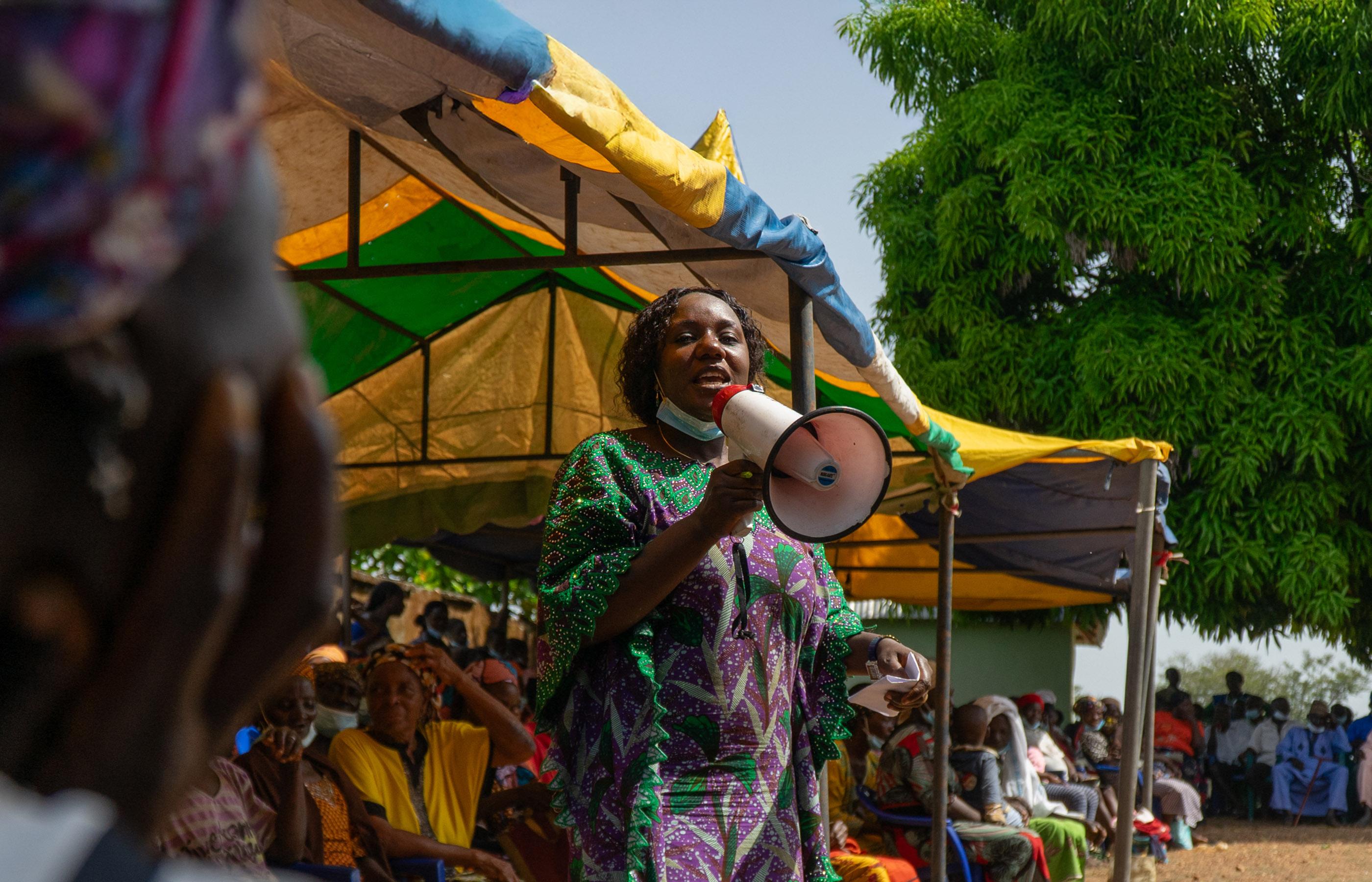
A second of mournful silence passes, and then from every corner of the courtyard — from the scores of people seated beneath blue tarps to the dozen or so clustered within the shadow of a solitary tree — comes a great wave of applause. The performance has been a great success.
That is exactly what this scene in the courtyard of the Kuchingoro Primary Health Care Centre has been: a performance, staged for the benefit of the nearly 200 people who have gathered this morning outside Nigeria’s capital city of Abuja. The nurse is no actor but Victoria Okwute, the health center’s chief nursing officer, and the occasion is a Rotary-supported workshop organized to address the shockingly high numbers of deaths that accompany childbirth in Nigeria.
No country has greater instances of maternal death than Nigeria. In 2020, 82,000 pregnant women and new mothers died there, nearly four times the maternal fatalities in India, where the second-most deaths occur.
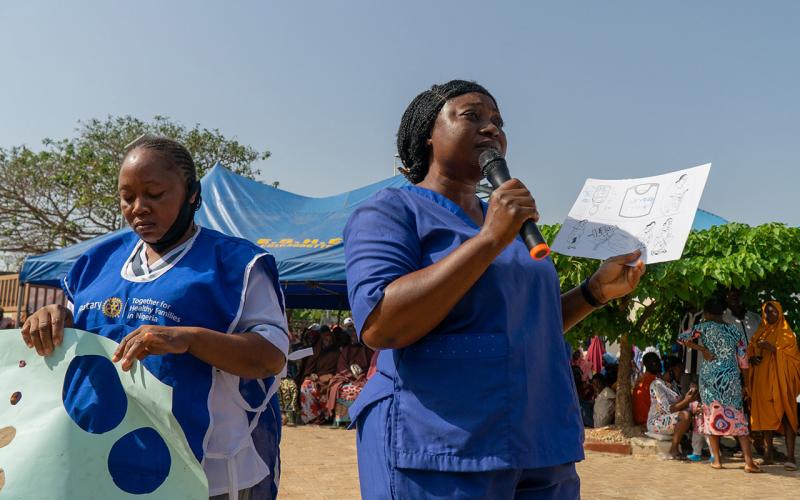
Now a $2 million Programs of Scale grant from The Rotary Foundation is addressing this problem head on. Its goal is to reduce maternal and neonatal mortality by 25 percent in target areas at the end of the three-year program. Known as Together for Healthy Families in Nigeria, the initiative is sponsored by Rotary District 1860 (Germany) in partnership with Districts 9110, 9125, 9141, and 9142 (Nigeria), as well as the Rotary Action Group for Reproductive, Maternal, and Child Health.
Unfolding in targeted areas within three Nigerian states and the Federal Capital Territory, the initiative builds on previous work by Rotary members in the country. It’s hoped that, once the program demonstrates its effectiveness, it will be replicated across Nigeria and elsewhere. Critically, Rotary members are partnering with federal and state agencies in implementing the program to ensure the intervention and its benefits last far longer than the three years of the grant cycle. “This project is going to birth more projects,” insists Toyosi Adebambo, the program’s manager.
Adebambo previously spent 16 years at USAID and its implementing partners in roles ranging from monitoring and evaluation, administration and human resources, to project management. He joined Rotaract in 2004 while he was a statistics major in college and later became a member of the Rotary E-Club of One Nigeria. When he heard about the Programs of Scale grant, he applied to work on the initiative. “When you start looking at what it will look like in 10, 20 years, you want to be there to make sure it actually works out,” he says. “Nobody is going to do it better than a Rotarian.”
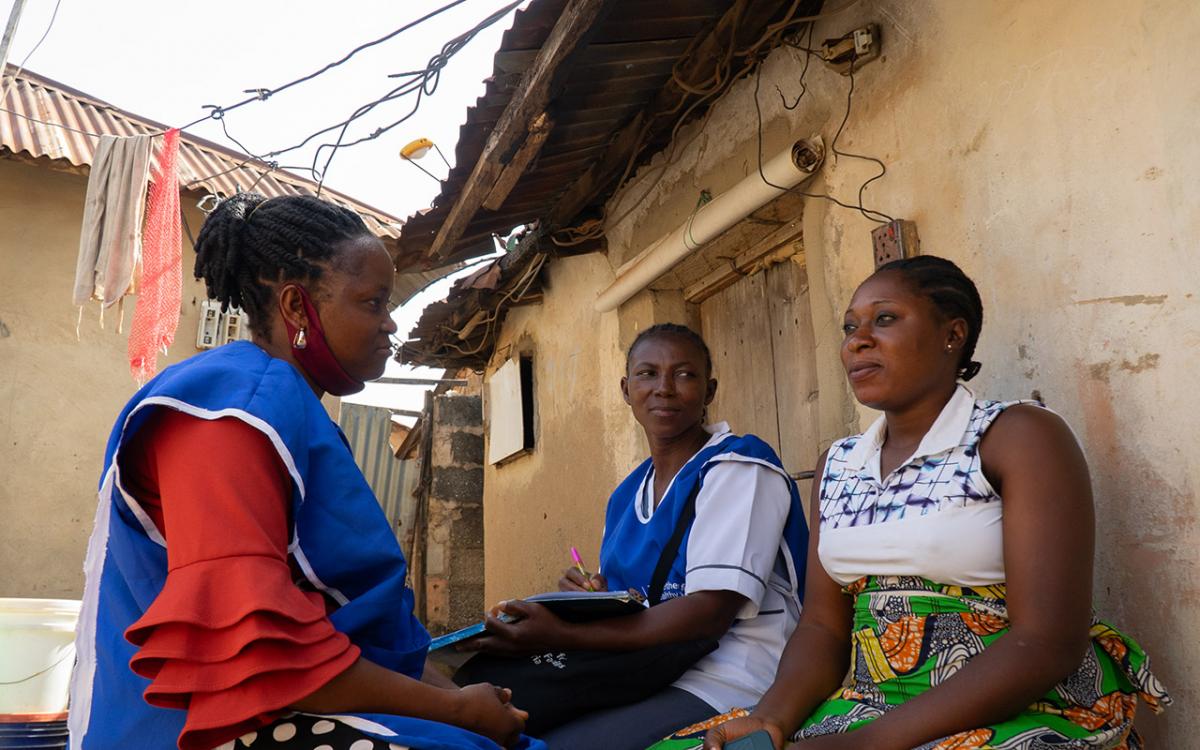
Faith Gideon and Judith Anyah visit a pregnant Theresa Andrew.
Later that day, after the courtyard skit, community health worker Faith Gideon leaves the Kuchingoro health center wearing a blue “Together for Healthy Families” apron and proceeds along a series of red dirt roads before arriving at the home of Theresa Andrew.
Seated across from Andrew, who is five months pregnant with her first child, Gideon encourages the expectant mother to visit the clinic at the first sign of trouble. “If you have any problems,” she says, “if there is anything you don’t understand, if the baby is not kicking, anything at all.”
Gideon goes on to talk about the dangers of malaria for pregnant women and gives Andrew a mosquito net. She also presents her with a birthing kit, which contains a bedcover, soap, umbilical cord tie, latex gloves, razor blade, and gauze. One of the reasons women give for not delivering at a clinic is the perception that it costs more, in part because they are often required to bring their own supplies.
Gideon makes this walk along the community’s red dirt roads three times a week to visit with pregnant women and new mothers. She’s one of 84 community health workers who, over two days last July, received training through the Rotary-supported initiative. Top participants at these trainings will become trainers themselves, helping to further expand the program.
The health workers learned about topics including basic prenatal and postnatal care, pregnancy complications, clinic referrals, home birth risks, and modern family planning methods. They learned how to educate expectant and new mothers on such topics as prenatal nutrition, breastfeeding, childhood immunizations, and when to introduce solid foods.
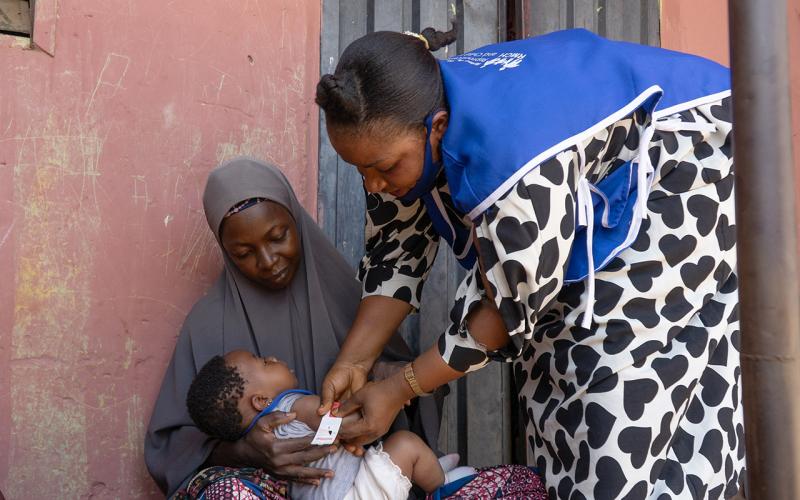
Health worker Melvina Tanze (right) checks on Nafisa Abubakar and her child, Halima Ode, during a home outreach visit in Nasarawa, Nigeria.
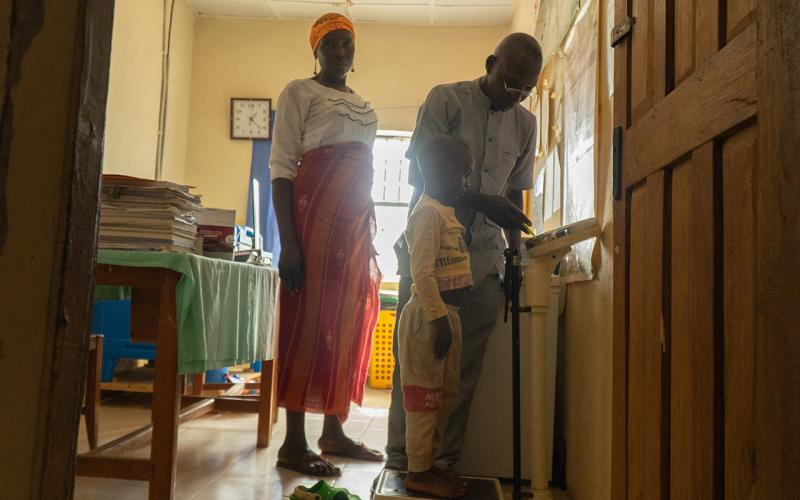
Home outreach visits supported by the program encourage families to visit health facilities.
Program organizers originally planned for these outreach visits to occur three times each quarter; they quickly pivoted once they realized their effectiveness. Now the health workers make the rounds three times each week — which means that, in its first three months, the initiative surpassed its three-year goal for number of visits. “When we get to people’s homes, we relate to them, we talk to them,” Gideon says. “It makes them feel comfortable and encourages them to come to the health center.”
And all of this is because of a chance meeting in a California hotel 30 years ago.
In March 1994, district governors-elect Emmanuel Adedolapo Lufadeju and Robert Zinser struck up a conversation while in California for Rotary’s annual International Assembly. Lufadeju, now a member of the Rotary Club of Ibadan-Jericho Metro, Nigeria, described a visit he’d recently made to a hospital maternity ward in Nigeria; Zinser, a member of the Rotary Club of Ludwigshafen-Rheinschanze, Germany, listened intently. That conversation sparked a 30-year partnership between Nigerian and German Rotary members who worked to improve maternal and child health and birthed the Rotary Action Group for Reproductive, Maternal, and Child Health, culminating in the recent $2 million Programs of Scale grant.
Along the way, Rotary members began to focus on collecting data on maternal deaths to uncover quality of care issues and help determine which interventions made the most sense. Their surveillance work became integrated into the Nigerian health system. Rotary members also supported government officials in introducing a bill, passed by the Nigerian Parliament in 2021, that required the accurate reporting of maternal deaths. Since the majority of women in the country give birth outside of medical facilities, no records had previously been kept on the cause of their deaths.
The Together for Healthy Families in Nigeria initiative is looking at compliance rates for this reporting, focusing on facilities in three states and the Federal Capital Territory where the program was initiated. In the first quarter of 2023, only 8 percent of facilities were properly reporting their data. The team held a flurry of meetings and calls with government leaders, and by the end of the fourth quarter, they had increased that rate to 90 percent. “The next stage is to relate this data to quality of care and have discussions with ministers of health in various locations about what we’re finding and what they will do to rectify any issues,” Lufadeju says. “Luckily we have good relationships.”

Emmanuel Adedolapo Lufadeju began working with German Rotarians on maternal health efforts in 1994.
Lufadeju, a Rotary member since 1980, was appointed chair of a subcommittee on safe motherhood within the Nigerian health agency in August 2023. His assignment helped open doors for Rotary members to advocate for additional resources. “When I ask for a meeting [with federal health officials], they don’t say no,” Lufadeju says. “They cannot tell me they don’t have time, because I am a principal stakeholder. I am part and parcel of their system.”
At the National Primary Health Care Development Agency in Abuja, Lufadeju warmly greets Chris Elemuwa, the agency’s director of social mobilization and community development. Lufadeju is here to petition the agency to absorb responsibility for the community dialogues and the maternal and child death data. Part of the Rotary program team’s strategy is not merely to execute the interventions over the next three years, but to convince the government to take them on long term.
Lufadeju had for years tried to make inroads at the agency, which supports community health workers throughout the country. Finally, as the Programs of Scale grant was coming together, he emailed Elemuwa and requested a meeting. “We struck a real brotherhood,” says Lufadeju. “Everything we’re doing would not be possible without him.”
Two days after the meeting between Lufadeju and Elemuwa, the program team engages in another advocacy visit, this time with the Ministry of Health in Nasarawa, a predominantly agricultural state southeast of Abuja. Along one side of a long conference table sit six directors within the ministry, people who oversee everything from medicine and reproductive health to — and this is key — finance and planning. On the other side of the table sits the Rotary program team.
After a few jokes and an exchange of complimentary speeches, the two teams get down to business. The state has started using some of its staff to supplement the program’s home outreach visits, and government officials are interested in a midterm assessment to see which interventions are supported by data. They also want to know what they should be doing differently right now in communities outside of the program locations. The finance director is already looking to make sure pieces are in place for when the Rotary program is complete. “We want them to take it over, and the only way they can take it over is to embed it in the state program and budget for it,” Lufadeju explains.
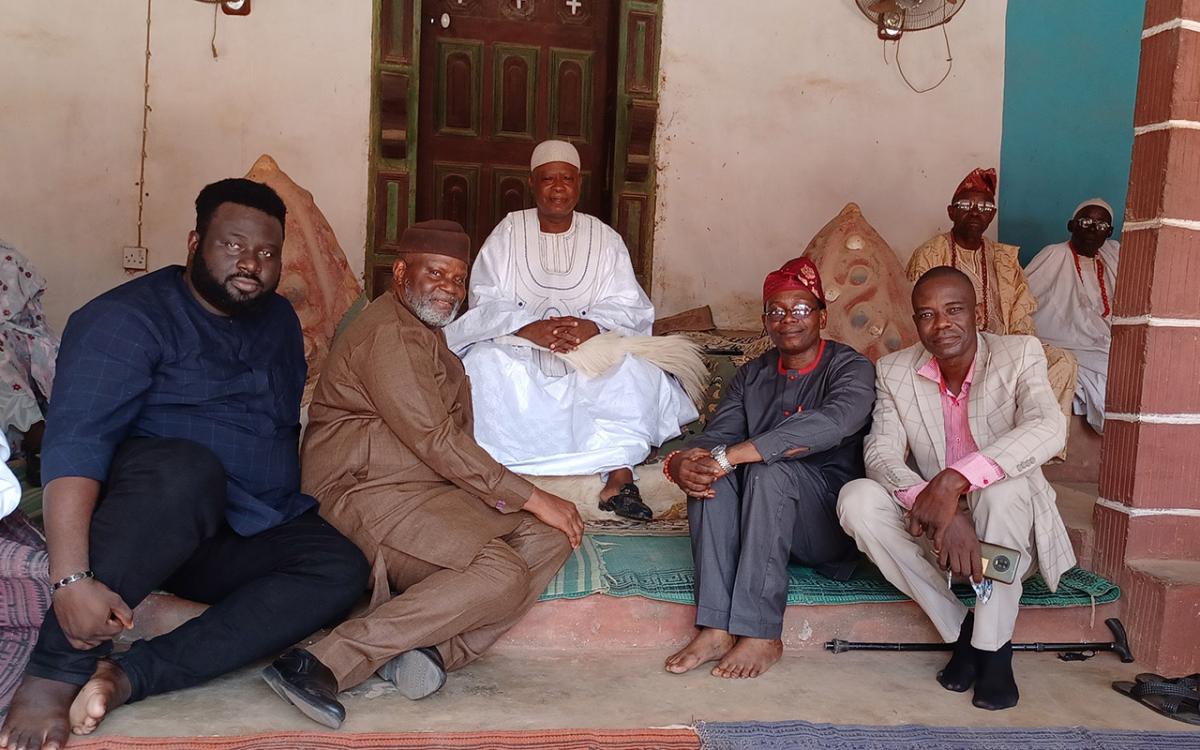
Rotary members (from left) Toyosi Adebambo and Emmanuel Adedolapo Lufadeju at the palace of a traditional leader in Ekiti state.
The Rotary program team is doing similar advocacy work on the community level, working with local religious, traditional, youth, and business leaders and asking them what they’d like to see. “The king and chief of each place have started talking about how to help us,” recalls Adebambo, the program manager. “It’s not really a question anymore about if they’ll help us.”
A tour of the Wamba Road Primary Health Centre in Akwanga, Nasarawa state, shows the Programs of Scale initiative at work. As part of the program, pregnant women have been assigned to cohorts depending on their due dates, and the members of those groups come together to the clinic for each of their seven prenatal visits.
Research backs this kind of group approach to prenatal care. It creates a sense of social camaraderie among the women, further reinforcing the necessity to keep up with their prenatal visits. Surprisingly, even as the number of women coming to the clinic increases, the ability to accomplish a number of tasks collectively decreases the workload for the clinic staff.
When the program started, this center received about 75 prenatal visits per month. In the first six months of the program’s implementation, the number increased to about 185. The community outreach portion of the program started in June, and after that, visits skyrocketed to about 570 per month. Not all of the women who come to the prenatal clinics are giving birth at the facilities, but still, those rates are climbing, jumping in three months from 18 percent of prenatal attendees to 66 percent. Postnatal care, including immunizations, leaped from 2 percent of attendees to 70 percent. “The impact is huge,” Adebambo says. “That is the fun part of it.”
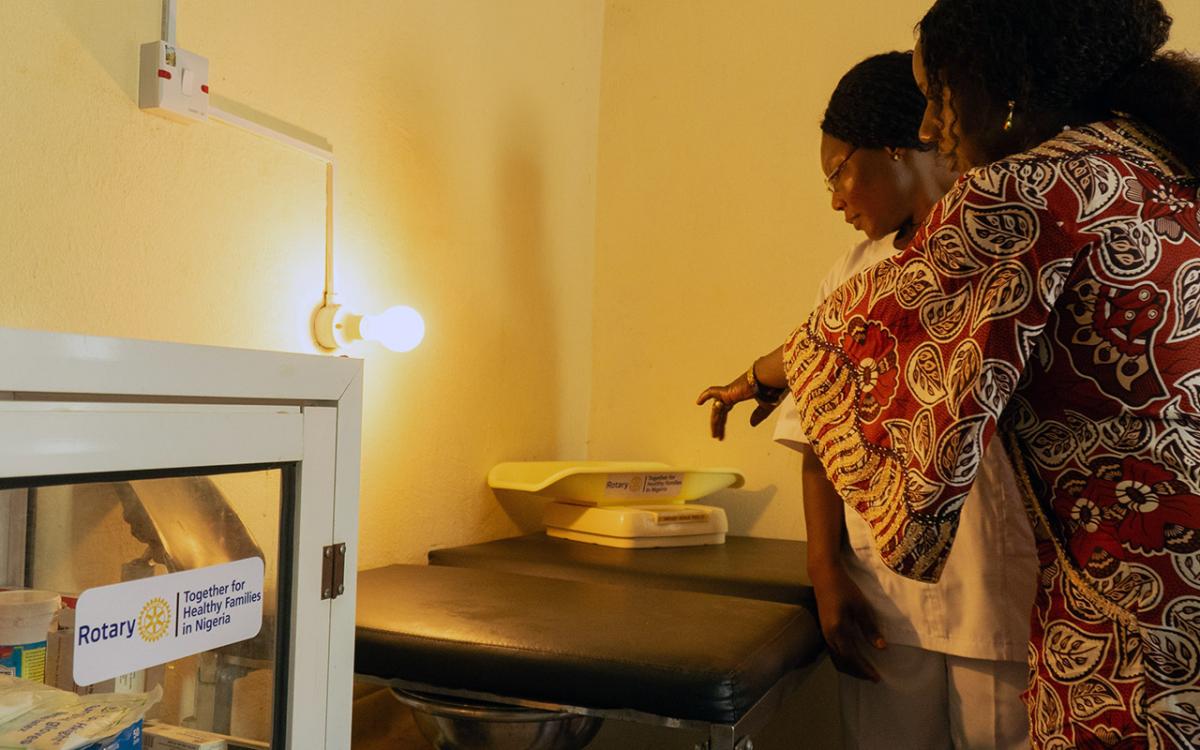
Charity James (left) and Ashezi David Alu examine supplies provided through the program.
For th erest of the story please click HERE